Use of IoT and Artificial Intelligence (AI) in the
mining industry for two critical areas:
- Fleet Management & Optimization
- Video Surveillance & Security Monitoring
These technologies help mining companies
increase operational efficiency,
reduce costs, and
enhance safety across their vehicle fleet and remote sites.
🚚 1. IoT & AI in Fleet Management & Optimization in Mining Industry
✅ Overview
Mining fleets consist of
haul trucks, loaders, bulldozers, graders, water carts, light vehicles, and drills, which must be monitored, scheduled, and maintained effectively. IoT and AI provide real-time operational intelligence and
predictive optimization of these mobile assets.
📡 A. IoT Contributions in Fleet Management
1. Vehicle Telemetry & Tracking
- GNSS (GPS + GLONASS) modules track real-time vehicle position, speed, heading, and route.
- Onboard telematics units collect data from engine control modules (via CAN bus):
- Fuel level
- Engine temperature
- Idling time
- Load per trip
- Brake status
2. Sensor Integration
- Load sensors measure the payload for each haul.
- Tire Pressure Monitoring Systems (TPMS) detect leaks or inflation issues.
- Fuel flow meters track actual consumption to identify theft or inefficiency.
3. Communication Networks
- Data transmitted via private LTE, satellite, or mesh networks in remote mines.
- Gateways or mobile edge devices pre-process telemetry data before sending to the cloud.
🤖 B. AI Contributions in Fleet Optimization
1. Route Optimization
- AI algorithms (Dijkstra, A*, genetic algorithms) find the shortest and most fuel-efficient haulage routes.
- Live road conditions, inclines, and congestion are factored in for real-time rerouting.
2. Cycle Time Optimization
- Machine learning models analyze loading → hauling → dumping → return
- AI identifies bottlenecks, underutilized trucks, or idle shovels to optimize match capacity.
3. Fuel Usage Prediction
- AI forecasts fuel usage per shift based on:
- Load size
- Route topography
- Operator behavior
- Helps identify excessive fuel usage due to aggressive driving or idling.
4. Predictive Maintenance of Fleet
- AI models trained on sensor and maintenance data forecast:
- Engine failures
- Transmission wear
- Brake system faults
- Automates work order generation in the CMMS.
🧠 C. Benefits of IoT + AI in Fleet Management
| Benefit Area |
Improvement |
| Fuel Efficiency |
10–15% cost reduction |
| Fleet Utilization |
+20% increase in productivity |
| Downtime |
Reduced by 25–40% via predictive maintenance |
| Safety |
Improved by route compliance & fatigue detection |
| Manual Intervention |
Drastically reduced with automation |
📊 Fleet Management Architecture Diagram

🎥 2. IoT & AI in Video Surveillance in Mining
✅ Overview
Mining sites require extensive
24/7 surveillance for worker safety, equipment security, environmental monitoring, and compliance. Traditional CCTV is passive.
IoT-enabled smart video surveillance systems with
AI computer vision are
proactive and intelligent.
📡 A. IoT Contributions in Video Surveillance
1. Smart Cameras
- IP cameras with thermal, infrared, night vision, and pan-tilt-zoom (PTZ) capabilities.
- Connected via PoE, 4G/5G, or fiber optics to local NVRs or cloud storage.
2. Edge Video Processing
- Onboard processing in cameras or edge boxes runs basic analytics (motion detection, object counting).
- Reduces latency and bandwidth usage by processing footage locally before transmitting.
3. Environmental Integration
- Video feeds combined with IoT environmental data (e.g., gas leaks, temperature spikes, unauthorized access) to provide situational awareness.
🤖 B. AI Contributions in Video Surveillance
1. Intrusion Detection & Perimeter Security
- AI computer vision models (YOLOv7, OpenCV, DeepStream) detect:
- Unauthorized personnel in restricted zones
- Vehicle intrusions at odd hours
- Fence breaches or perimeter violations
2. PPE & Safety Compliance Monitoring
- CV models identify:
- Helmet use
- Reflective vests
- Safety boots
- Real-time alerts sent to supervisors if safety gear is missing.
3. Operator Behavior Monitoring
- Fatigue detection using facial landmarks (eye blinking, yawning).
- Detection of unsafe behaviors (phone use, smoking near flammable storage).
4. Fire, Smoke, and Spill Detection
- Thermal imaging + AI models identify:
- Spontaneous combustion
- Leaking tanks or chemical spills
- Automated escalation: sirens, SMS alerts, camera zoom on the hazard.
🧠 C. Benefits of Smart Surveillance
| Use Case |
Benefit |
| Intrusion Detection |
24/7 real-time alerts, reduced security personnel |
| Safety Compliance |
Continuous PPE monitoring, better incident control |
| Theft Prevention |
Visual logs + automated response |
| Emergency Response |
Faster detection of fire/gas leaks with location tagging |
| Data Storage |
Reduced by filtering only relevant events |
📊 Smart Surveillance System Architecture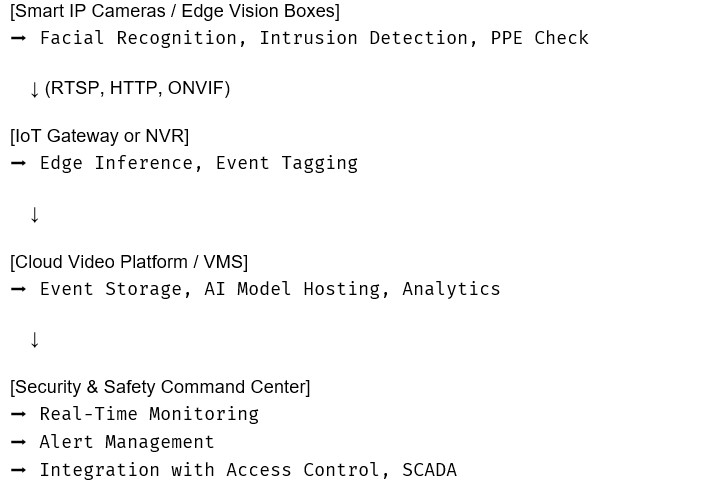
✅ Combined Applications: Fleet & Surveillance Synergy
- Cameras on trucks monitor loading activity, operator fatigue, and unsafe behavior.
- Video analytics cross-referenced with fuel consumption, trip logs, and geolocation to detect:
- Ghost trips
- Misuse of vehicles
- Material theft
🔄 Summary of Key Benefits
| Domain |
IoT & AI Value |
| Fleet Efficiency |
Optimized cycle times, fuel savings |
| Safety |
PPE enforcement, route compliance |
| Asset Protection |
Theft alerts, camera-based evidence |
| Environmental Monitoring |
Visual confirmation of spills or damage |
| Labor Productivity |
Reduced supervision effort |
| Cost Control |
Less idling, lower maintenance, fewer incidents |