How
IoT (Internet of Things) and
Artificial Intelligence (AI) are used for
Remote Operation and Automation in the Mining Industry, including systems architecture, technologies involved, and benefits:
⚙️ 1. Introduction
Modern mining operations—especially in
deep, remote, hazardous, or highly mechanized environments—are increasingly adopting
remote operation centers (ROCs) powered by IoT and AI to:
- Improve safety
- Reduce human error
- Operate 24/7
- Increase precision and efficiency
- Reduce costs of onsite manpower
📡 2. IoT Components Enabling Remote Operations
A. Sensors and Actuators
- Mounted on mining equipment (drills, excavators, haul trucks, crushers, conveyors, etc.)
- Collect real-time data: engine load, fuel consumption, RPM, vibration, hydraulic pressure, temperature, alignment, payload
B. Positioning and Tracking
- GPS/GNSS systems for equipment localization
- IMUs (Inertial Measurement Units) for orientation and movement tracking
C. Industrial IoT Gateways
- Aggregates sensor data
- Performs initial filtering and preprocessing
- Connects to cloud or local edge servers via Ethernet, 4G/5G, LoRaWAN, or private LTE
D. CCTV & Machine Vision
- Real-time video from crushers, loading zones, and conveyors
- AI-powered vision used for anomaly detection, worker safety, and equipment control
E. Connectivity Infrastructure
- Mesh networks, fiber optics, 5G, VSAT, microwave backhaul, or private LTE for data transmission
🤖 3. AI Applications for Remote Operation & Automation
A. Autonomous Haulage Systems (AHS)
- AI-driven algorithms navigate and control driverless haul trucks
- Path planning, collision avoidance, payload optimization
- Example: Komatsu FrontRunner, CAT MineStar Command
B. Drill Automation
- AI optimizes drill depth, feed rate, and bit pressure based on rock hardness data
- Reduces over-drilling and bit wear
- Autonomous drilling rigs can operate unmanned with remote supervision
C. Autonomous Load-Haul-Dump (LHD) Vehicles
- LHDs navigate underground autonomously using LiDAR and SLAM (Simultaneous Localization and Mapping)
D. AI-Based SCADA Integration
- Remote SCADA/HMI with AI models to:
- Adjust conveyor speeds
- Auto-start/stop pumps, crushers, mills
- Switch power loads or ventilation based on real-time demand
E. Predictive Control with Digital Twins
- Digital replicas of assets and process lines simulate various scenarios
- AI models suggest operational adjustments in real-time
F. AI-Based Scheduling
- AI creates shift-free task schedules for autonomous equipment
- Real-time adjustment based on breakdowns, terrain, or productivity needs
🧩 4. System Architecture for Remote Automation 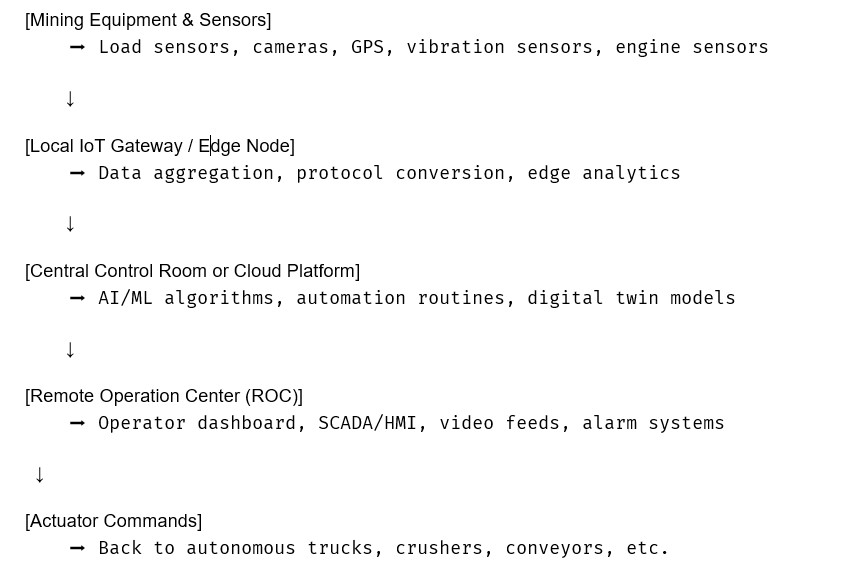
🧪 5. Key Use Cases
✅ 1. Autonomous Truck Operations
- No drivers needed on-site
- AI handles route optimization, haul cycles, and obstacle detection
- Human operator intervenes only in complex scenarios remotely
✅ 2. Remote Drilling Control
- Drill parameters controlled from ROCs
- Multiple rigs can be operated by a single technician
- Reduces human exposure in explosive-prone or deep-pit zones
✅ 3. Remote Crusher and Conveyor Control
- Based on belt load sensors, ore moisture, and particle size from vision systems
- AI adjusts crusher gap or conveyor speed autonomously
✅ 4. Remote Blasting Planning
- AI uses geospatial and rock density data to suggest blast patterns
- Integrated with drone-based mapping and vibration monitoring
✅ 5. Process Plant Automation
- Remote control of leaching, flotation, and thickening tanks via AI-based control loops
- Automated chemical dosing based on pH, turbidity, and ORP readings
📊 6. Benefits
| Benefit |
Description |
| 🧍♂️ Fewer People Onsite |
Improves safety and reduces cost of remote manpower deployment |
| 🕹️ 24/7 Operation |
Autonomous and remote systems can operate continuously |
| 📉 Downtime Reduction |
AI identifies faults early, adjusts operations before failure |
| ⚡ Energy Efficiency |
AI optimizes equipment runtime and energy consumption |
| 🎯 Precision and Repeatability |
Improves quality and consistency of drilling, hauling, processing |
| 🌍 Multi-site Operation |
Central ROCs can operate multiple mines from hundreds of kilometers away |
🛠️ 7. Technologies Commonly Used
| Technology |
Application |
| LiDAR/SLAM |
Autonomous vehicle navigation in underground mines |
| Edge Computing |
Real-time decisions with low latency onsite |
| AI/ML |
Optimization, scheduling, predictive maintenance |
| IoT Sensors |
Real-time telemetry from equipment |
| Private 5G / LTE |
High-bandwidth low-latency communication in remote areas |
| Computer Vision |
Load detection, personnel tracking, hazard monitoring |
🧭 8. Example – Remote Operation Center Layout
- Large wall displays for real-time telemetry
- Workstations for:
- Autonomous truck fleet monitoring
- Crusher & conveyor control
- AI anomaly alerts
- Drill rig supervision
- Video surveillance feeds from multiple mine zones
- AI dashboard showing equipment KPIs, safety metrics, energy usage
🔒 9. Security & Reliability
- Encrypted communication (TLS/SSL, VPN)
- Multi-factor authentication for remote access
- Redundant communication links (fiber + satellite)
- Fail-safe mode to allow manual override if automation fails