FOG CANNON TECHNOLOGY FOR WASTEWATER EVAPORATION IN MINING INDUSTRY, MECHANICAL EVAPORATORS
1. Introduction
Mining operations generate large volumes of wastewater—typically containing high concentrations of dissolved salts (TDS), metals, and sometimes process chemicals—that are difficult to treat or discharge due to environmental regulations. Conventional methods like evaporation ponds are land-intensive, slow, and climate-dependent.
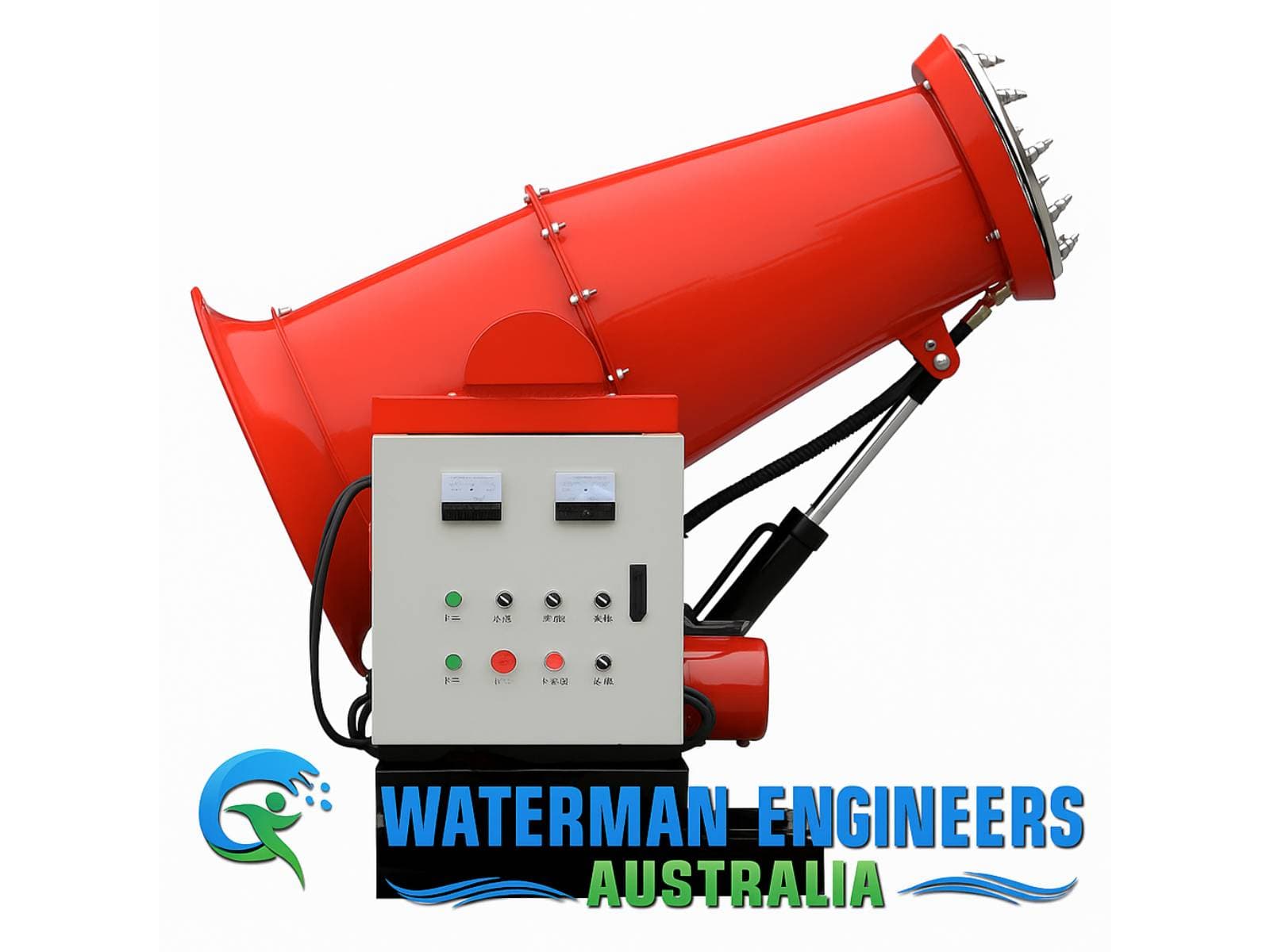
Fog cannon technology, also called
spray evaporation systems, offers a simple, scalable, and low-cost alternative or supplement to traditional evaporation ponds or mechanical evaporators. By converting wastewater into ultra-fine droplets, the technology promotes rapid evaporation into the atmosphere, reducing liquid volumes for final disposal.
The Fog Cannon Evaporation System for mining wastewater management is an
atmospheric spray evaporation unit, designed to reduce the volumetric load of saline or brine-rich effluents in remote or arid mining locations where conventional treatment methods (like reverse osmosis or thermal evaporators) are economically or technically unviable.
2. Technology Overview
2.1 Working Principle
- Fog cannons atomize wastewater into tiny droplets (<100 μm) using high-pressure nozzles.
- A powerful fan projects the fog into the open air or towards designated areas (ponds, tailings).
- The fine mist rapidly evaporates as droplets interact with ambient air—boosted by sun, wind, and low humidity.
- The system enhances natural evaporation rates by a factor of 3–10 times compared to static pond surfaces.
2.2 Process Advantages
| Feature |
Details |
| High Surface Area |
Fine droplets dramatically increase the water-air interface. |
| Minimal Energy Input |
No need for heating or thermal input—only pumps and fans required. |
| Portable/Skid-Mounted |
Easy deployment near pits, ponds, tailings, or mobile operations. |
| Low Maintenance |
Simple components, corrosion-resistant materials, easy cleaning. |
| Environmental Control |
Also effective for dust suppression, reducing PM emissions. |
3. Detailed Process Flow Diagram (Expanded)
Raw Wastewater from Mine Operations
│
▼
[1] Pre-Treatment System
(Coarse filtration, pH adjustment, anti-fouling dosing)
│
▼
[2] Storage/Feed Tank
(Level sensor, agitation, buffer volume)
│
▼
[3] High-Pressure Pump Station
(10–60 bar, variable flow rate, pressure control)
│
▼
[4] Fog Cannon Unit with Atomizing Nozzles
(Nozzle array, oscillating axial fan, throw range 30–100 m)
│
┌────────────────────────────┴─────────────────────────────┐
▼ ▼
[5a] Droplet Evaporation (to Atmosphere) [5b] Large Droplet Settling
▼ ▼
Evaporated water removed from site Collected in Recovery Sump / Basin
4. Key Equipment Specifications
| Component |
Description |
Typical Values |
| Pump Type |
High-pressure centrifugal or piston pump |
10–60 bar |
| Fog Cannon Fan |
Axial fan, 5–50 kW, oscillating head |
Air throw 30–100 m radius |
| Nozzle Array |
Stainless steel / ceramic, anti-clog |
30–100 μm droplet size |
| Flow Capacity |
Variable flow to match evaporation need |
5–40 m³/h |
| Control Panel |
VFD, PLC/SCADA, remote monitoring |
Fully automated available |
| Materials |
316SS, duplex, HDPE, polymer coatings |
Suitable for saline/acidic waste |
| Mobility Option |
Skid-mounted, trailer-mounted, or stationary |
Site-dependent |
5. Evaporation Performance Factors
| Parameter |
Impact on Evaporation Rate |
| Ambient Temperature |
Higher temps increase evaporation potential. |
| Relative Humidity |
Lower RH enhances evaporation efficiency. |
| Wind Speed |
Increases droplet carry distance and drying. |
| Droplet Size |
Smaller droplets (30–60 μm) evaporate faster. |
| Spray Height |
Higher elevation gives longer air exposure. |
| Salinity of Water |
High TDS reduces vapor pressure, slowing evaporation slightly. |
Typical Evaporation Enhancement: 3–10 times pond evaporation rate depending on conditions.
6. Energy Consumption Comparison
| Evaporation Method |
Energy Consumption (kWh/m³ evaporated) |
Remarks |
| Fog Cannon Evaporation |
5–10 (fan & pump only) |
Low-cost, ambient energy use |
| Forced Circulation Evaporator |
60–100 |
Requires thermal input (MVR/steam) |
| Thermal Evaporator (Direct)** |
200–400 |
Highest energy consumption |
7. Environmental and Operational Considerations
| Aspect |
Considerations |
| Aerosol Drift |
Possible drift downwind; must monitor wind direction/speed. |
| Salt Fallout |
Droplets settling may concentrate salts—plan collection basins. |
| Noise Levels |
~80–90 dB(A) at source—hearing protection zones needed. |
| Spray Zone Control |
Oscillation, flow regulation, and fan angle adjustment control spray area. |
| Automation |
SCADA-integrated units available for weather-responsive operation. |
8. Pre-Treatment Requirements
Fog cannons require
filtered wastewater to avoid nozzle clogging:
| Parameter |
Typical Limit |
| Suspended Solids (TSS) |
< 50 mg/L (ideally < 10 mg/L) |
| Oil & Grease |
< 5 mg/L |
| pH |
6–9 (to prevent corrosion or scaling) |
| Particle Size |
< 100 μm (post-screening/filtration) |
10. Maintenance & Safety Schedule
| Task |
Frequency |
Remarks |
| Nozzle Cleaning |
Every 3–6 months |
Remove scaling/fouling. |
| Filter Replacement |
Every 3–6 months |
Prevent solids entry. |
| Pump Seal Inspection |
Every 6 months |
Replace worn seals to avoid leaks. |
| Fan Motor Lubrication |
Annually |
Reduce mechanical wear. |
| SCADA Check / Software |
Quarterly |
Ensure automation reliability. |
12. Conclusion
Fog cannon evaporation systems offer a
simple, scalable, and cost-effective method for volume reduction of mining wastewater—especially for brine and tailings waters—when conventional disposal options are limited or uneconomical. However, successful implementation requires careful
site-specific design considering wind patterns, water quality, droplet control, and environmental impact.
Control & Automation (Instrumentation and Control - I&C)
| Device |
Purpose |
| Level Transmitter (LT) |
Monitors feed tank level to prevent pump dry run. |
| Pressure Transmitter (PT) |
Ensures pump discharge within design limits. |
| VFD (Variable Frequency Drive) |
Modulates pump/fan speed to suit weather or process demands. |
| Wind Vane/Anemometer |
Prevents fog cannon operation during adverse wind conditions (to avoid offsite drift). |
| PLC/SCADA Integration |
Full system automation with alarms, remote control, and data logging. |
Mechanical & Structural Considerations
- Mounting: Skid-mounted or trailer-mounted for mobility on mining sites.
- Corrosion Resistance: All wetted parts in contact with saline/brine designed in 316L stainless steel, duplex stainless, or polymer-lined materials.
- Vibration Isolation: Critical for pump skid and fan motor assembly to prevent mechanical fatigue and noise emission.
- Drainage and Frost Protection: System designed to drain under freezing conditions (if applicable to site).
Engineering Advantages Summary
| Feature |
Engineering Benefit |
| Modular Design |
Easily scalable for increasing wastewater volumes. |
| Energy Efficient |
~5–10 kWh/m³—no thermal energy required. |
| Low CAPEX/OPEX |
Reduced capital and operating costs compared to thermal evaporators. |
| Simple Maintenance |
Minimal moving parts; nozzle and pump checks only. |
| Portable Deployment |
Can be relocated or repositioned as mine pit progresses. |
Safety and Risk Considerations
- Salt Fallout Control: Periodic cleanup or capture system at droplet settling zone.
- Wind Drift Mitigation: Interlock with wind sensors to shut down during high-speed gusts.
- Electrical Safety: IP65-rated enclosures for outdoor operation; grounding as per IEEE standards.
- Worker Safety: Hearing protection in proximity; exclusion zones for spray area.