Comparative Analysis of MED-TVC and MED-MVR for Seawater Desalination
1. Basic Principle of Operation
| Aspect |
MED-TVC |
MED-MVR |
| Vapour Compression Method |
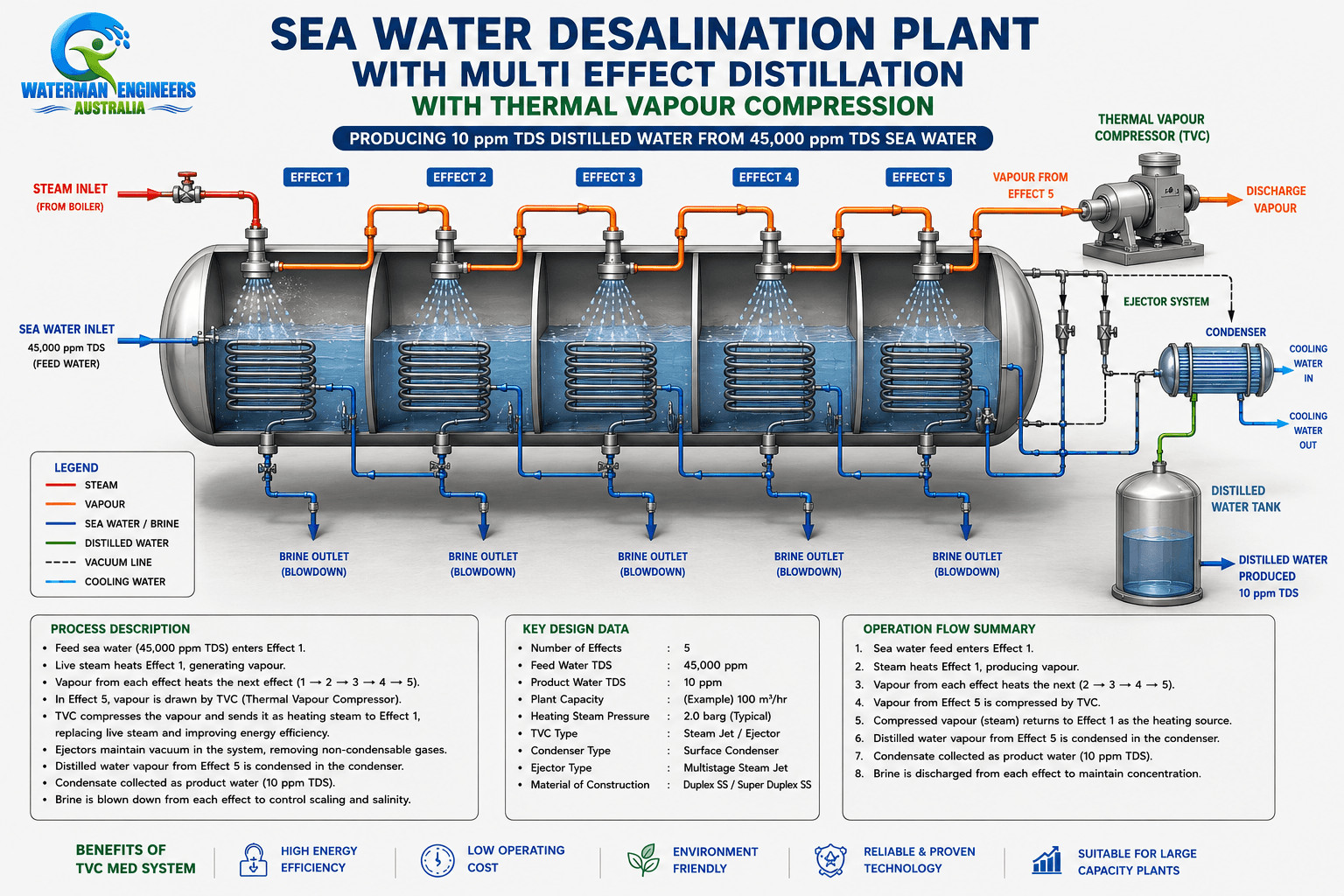
Uses Thermal Vapour Compression: High-pressure steam (motive steam) entrains and compresses vapour from the last effect using an ejector (jet compressor). |
Uses Mechanical Vapour Recompression: A mechanical compressor (usually centrifugal or Roots blower) recompresses the vapour mechanically to a higher pressure. |
| Primary Energy Source |
Thermal energy (steam) from an external source such as boilers, waste heat, or power plants. |
Electrical energy driving the mechanical compressor (electricity-driven). |
| Driving Force |
Steam pressure difference; ejector entrainment efficiency governs performance. |
Compressor work; pressure and temperature rise achieved mechanically. |
| Vapour Handling |
Non-condensable gases and excess vapour are discharged after each stage or sent to ejector. |
Almost all vapour is recompressed and reused; minimal losses to atmosphere. |
2. Energy Consumption
| Aspect |
MED-TVC |
MED-MVR |
| Specific Energy
Consumption (SEC) |
Typically 25–45 kWhₑ/m³ equivalent (when considering steam energy in primary form). |
5–15 kWhₑ/m³, primarily electrical energy. Lower total energy input. |
| Thermal Energy Requirement |
Significant; needs high-pressure motive steam (e.g., 2–6 bar). |
Minimal or no thermal energy required; mostly electrical energy. |
| Electrical Energy Requirement |
Very low (0.5–2 kWhₑ/m³) for pumps and controls. |
Higher electrical consumption (5–15 kWhₑ/m³) due to compressor load. |
| Energy Source Dependency |
Depends on steam supply from boilers or process waste heat. |
Fully dependent on reliable electricity supply. |
3.Plant Complexity & Components
| Aspect |
MED-TVC |
MED-MVR |
| Main Components |
Effects, vapour ejector (TVC), condensers, pumps. |
Effects, mechanical compressor, heat exchangers, pumps. |
| Mechanical Complexity |
Lower; TVC has no moving parts, simpler operation. |
Higher; compressor needs maintenance, bearings, seals. |
| Instrumentation Requirement |
Standard process control instrumentation. |
Additional monitoring and control for compressor operation. |
| Maintenance |
Lower; TVC is robust and requires minimal servicing. |
Higher; mechanical compressor requires regular inspection, overhaul. |
- Scalability & Capacity
| Aspect |
MED-TVC |
MED-MVR |
| Ideal Capacity Range |
Medium to large-scale plants (10,000 – 1,000,000 m³/day). |
Small to medium-scale plants (500 – 30,000 m³/day). |
| Scalability |
Easily scalable; TVC adapts well to large units. |
Less scalable to large sizes due to mechanical compressor limits. |
| Flexibility |
Good with fluctuating steam sources (e.g., cogeneration). |
Good with reliable electrical supply; less suitable where grid power is unstable. |
5.Operational Aspects
| Aspect |
MED-TVC |
MED-MVR |
| Start-up Time |
Long (due to boiler/steam system warm-up). |
Faster; electrical start-up possible in minutes. |
| Control Stability |
Good; mature technology. |
High; but depends on compressor control system efficiency. |
| Part-Load Operation |
Efficient; TVC can adjust steam flow as needed. |
Part-load operation affects compressor efficiency; better at constant load. |
- Capital and Operating Costs
| Aspect |
MED-TVC |
MED-MVR |
| Capital Expenditure (CAPEX) |
Higher due to steam system (boiler, piping, TVC). |
Lower for small plants; higher if large compressors needed. |
| Operating Expenditure (OPEX) |
Lower electricity costs but higher thermal energy costs (unless using waste heat). |
Higher electricity costs but minimal or no thermal energy. |
| Maintenance Costs |
Low; mainly pumps and heat exchangers. |
Higher; compressor maintenance, spare parts, potential downtime. |
- Thermodynamic Performance
| Aspect |
MED-TVC |
MED-MVR |
| Gain Output Ratio (GOR) |
Moderate: 8–12 (depends on number of effects and steam quality). |
High: 15–22 due to efficient vapour reuse. |
| Thermodynamic Efficiency |
Lower; relies on continuous input of thermal energy. |
Higher; maximum vapour recycling reduces input energy. |
| Exergy Destruction |
Higher due to steam throttling in ejector. |
Lower; mechanical recompression reduces exergy losses. |
- Environmental Impact
| Aspect |
MED-TVC |
MED-MVR |
| CO₂ Emissions |
Depends on steam source (fossil-fuel boiler increases emissions unless waste heat used). |
Depends on grid power or renewable electricity; lower if green electricity is used. |
| Brine Discharge |
Similar for both; depends on desalination capacity and feedwater. |
Similar. |
| Chemical Usage |
Minimal; both require low antiscalant and biocide dosing. |
Minimal. |
9.
Suitability
| Criterion |
MED-TVC |
MED-MVR |
| Large-scale Plants (>100,000 m³/day) |
Preferred; better economics, robustness. |
Less common; compressor limitations for very large sizes. |
| Small/Medium Plants (<30,000 m³/day) |
Less economical. |
Preferred; low energy and small footprint. |
| Waste Heat Availability |
Ideal choice when integrated with power plants or industrial waste heat. |
Less effective; does not utilize low-grade heat. |
| Remote Locations with Unstable Power |
Better due to low electrical dependency. |
Risky due to reliance on stable electricity. |
- Summary Table
| Factor |
MED-TVC |
MED-MVR |
| Energy Source |
Thermal (steam) |
Electrical |
| Specific Energy Consumption |
25–45 kWhₑ/m³ (thermal equivalent) |
5–15 kWhₑ/m³ (electrical) |
| Operational Complexity |
Lower |
Higher (mechanical compressor) |
| Maintenance |
Low |
High |
| CAPEX |
Medium–High (due to steam system) |
Low–Medium |
| OPEX |
Medium (depends on steam cost) |
Potentially lower with cheap electricity |
| Scalability |
Large-scale preferred |
Small/Medium-scale preferred |
| Environmental Impact |
Depends on steam source |
Depends on electricity grid |
| Best Use Case |
Large desalination plants with waste heat |
|
Note: These are hypothetical figures and views; please do your own research while making decisions.